Mirwaiz Umar Farooq House Arrest: Why the Latest Restriction Ahead of Rabi-ul-Awwal Matters in Kashmir
By: News Desk | 14 Aug 2026
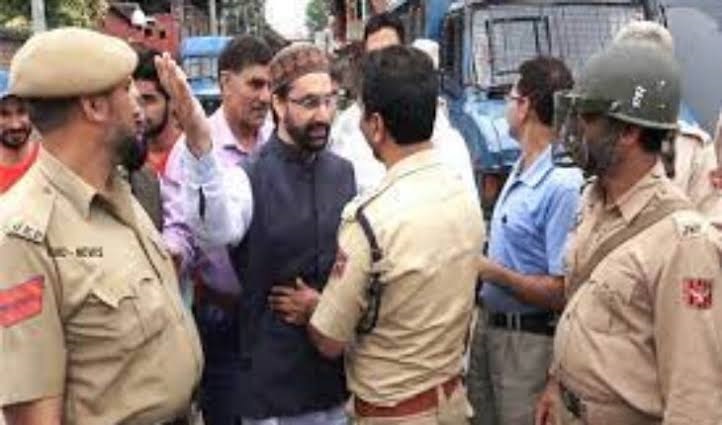
Srinagar: The reported restriction on Mirwaiz Umar Farooq, Kashmir’s chief cleric and chairman of the Hurriyat Conference, has once again brought the sensitive intersection of religion, civil liberties and security policy into focus.
According to the claim attributed to Mirwaiz and his supporters, authorities have restricted his movement at his Nigeen residence, preventing him from attending Friday prayers and carrying out his customary religious responsibilities at Srinagar’s historic Jamia Masjid.
The timing is significant. Rabi-ul-Awwal, the third month of the Islamic calendar and the month associated with the birth of Prophet Muhammad, carries considerable religious importance in Kashmir. Historically, the month has been marked by sermons, Seerat gatherings and large congregations.
However, the latest claim needs to be distinguished from what can be independently established. I could verify a long-running pattern of restrictions on Mirwaiz, including his house detention on Fridays in 2025 and again in early 2026, but I did not find a sufficiently reliable current report independently confirming the specific August 2026 house-arrest claim or the alleged link to his recent remarks about pork products. That distinction is important in responsible news reporting.
Why the Mirwaiz’s Movement Matters
Mirwaiz Umar Farooq is not simply a political figure.
He occupies a historically important religious position as the Mirwaiz of Kashmir and traditionally delivers the Friday sermon at Jamia Masjid in Nowhatta, Srinagar.
The mosque is far more than a place of worship. It is one of Kashmir’s most significant religious and cultural institutions and has historically served as a major gathering point for Muslims across the Valley.
When Mirwaiz is prevented from reaching the mosque, therefore, the immediate issue is not simply whether one individual can attend Friday prayers.
It affects a longstanding religious institution and the congregation that expects to hear his sermon.
That is why every such restriction generates a debate that extends beyond the individual involved.
A Pattern That Did Not Begin in 2026
The latest allegation is part of a much longer history.
Mirwaiz has repeatedly been restricted from attending Jamia Masjid during periods when authorities have anticipated political mobilisation, protests or possible law-and-order problems.
The pattern became particularly pronounced after August 2019, when the constitutional changes concerning Jammu and Kashmir were accompanied by sweeping restrictions and detentions.
The Anjuman Auqaf Jamia Masjid has repeatedly described the restrictions on Mirwaiz as interference in his religious responsibilities. Authorities, meanwhile, have generally viewed restrictions through the prism of security and law-and-order concerns.
That disagreement has remained unresolved.
2025: Restrictions Became a Regular Friday Issue
The scale of restrictions became particularly visible in 2025.
In April 2025, Mirwaiz said he was being placed under house arrest on Fridays to prevent him from addressing worshippers at Jamia Masjid. The Indian Express reported that he had been allowed to lead Friday prayers only occasionally and had approached the Jammu & Kashmir and Ladakh High Court over what he described as arbitrary detention.
In March 2025, authorities again restricted him to his Nigeen residence and prevented him from attending congregational prayers at Jamia Masjid. The move came shortly after the Union government declared his Awami Action Committee an unlawful association under the UAPA.
By the beginning of 2026, Mirwaiz said he had been placed under house arrest on 14 Fridays during 2025.
That figure was reported by Deccan Herald in January 2026, along with his claim that he was again restricted on the first Friday of 2026.
This makes one point difficult to dispute:
Restrictions on Mirwaiz’s Friday movements have become a recurring feature of Kashmir’s recent political-security landscape.
Rabi-ul-Awwal Has Its Own Significance
The timing of the latest claim is particularly sensitive because of Rabi-ul-Awwal.
The month is associated with the birth of Prophet Muhammad and is marked in Kashmir by religious gatherings, sermons and Seerat programmes.
The Mirwaiz traditionally plays an important role in these religious activities.
There is historical precedent for restrictions during Rabi-ul-Awwal.
In October 2021, when Mirwaiz remained under house arrest, the Anjuman Auqaf repeatedly appealed for his release so that he could resume his religious responsibilities during the month.
In September 2024, the Anjuman said Mirwaiz had again been placed under house arrest on the occasion of Khoja Digar, a congregational prayer traditionally observed on 3 Rabi-ul-Awwal at the Naqshband Sahib shrine in Srinagar.
The historical pattern therefore supports the broader point that religious occasions have previously coincided with restrictions on Mirwaiz’s movement.
Jamia Masjid: The Mosque at the Centre of the Debate
The controversy cannot be understood without understanding the significance of Srinagar’s Jamia Masjid.
Located in Nowhatta, the historic mosque has traditionally been one of the Valley’s largest congregational spaces.
The Mirwaiz’s Friday sermon has been an important part of that religious tradition.
Consequently, when the Mirwaiz is restricted, the issue can quickly become a community-wide concern.
The same happened in March 2026.
Jumat-ul-Vida Closure in 2026
On March 13, 2026, authorities did not allow congregational prayers at Jamia Masjid on Jumat-ul-Vida, the final Friday of Ramadan.
Mirwaiz said the mosque’s gates were locked and described it as the seventh consecutive year in which prayers on that occasion had not been allowed there. The Anjuman Auqaf also condemned the closure.
This is an important verified part of the recent timeline.
It demonstrates that the question of access to Jamia Masjid is not limited to one individual’s house arrest.
It also involves when and under what circumstances large congregations are permitted to assemble at the mosque.
Why Authorities Restrict Mirwaiz
The administration’s justification in such situations generally revolves around security and law-and-order concerns.
Jamia Masjid can attract large crowds.
Mirwaiz’s sermons can address religious, social and political issues.
In Kashmir’s highly sensitive environment, authorities may therefore assess that a large gathering could become a platform for political mobilisation or potentially lead to unrest.
From the government’s perspective, restricting an influential figure may be viewed as a preventive measure.
But this approach has a significant downside.
Preventive Security Can Create a Civil-Liberties Question
The central question becomes:
How long can preventive restrictions continue before they begin to resemble punishment without trial?
This is particularly relevant when restrictions affect a person’s ability to perform religious duties.
Security agencies have a legitimate responsibility to prevent violence.
At the same time, restrictions on movement and religious activity should be lawful, necessary, proportionate and subject to appropriate review.
That balance is at the heart of the controversy.
Mirwaiz’s Version: Restriction as Silencing
Mirwaiz has repeatedly rejected the idea that restrictions are simply security measures.
In April 2025, he alleged that house arrest was being used to prevent him from speaking about issues affecting Kashmiris and Muslims. He also said his detention case was pending before the High Court.
He described the repeated restrictions as an attempt to weaken institutions such as Jamia Masjid and the office of the Mirwaiz.
The Anjuman Auqaf has made a similar argument, saying repeated restrictions hurt religious sentiments and interfere with the religious role historically associated with the Mirwaiz.
These are claims made by Mirwaiz and the mosque management, and should be identified as such rather than presented as established fact.
The Political Dimension Cannot Be Ignored
Mirwaiz occupies an unusual position in Kashmir.
He is simultaneously:
- A senior religious figure
- The chief preacher associated with Jamia Masjid
- Chairman of the Hurriyat Conference
- A prominent voice on Kashmir’s political questions
That combination makes his sermons potentially more consequential than those of an ordinary cleric.
A Friday sermon by Mirwaiz can therefore carry religious, social and political meaning at the same time.
This dual role is one reason why authorities have historically treated his public appearances differently from those of many other religious leaders.
It is also why his supporters argue that restrictions amount to suppressing a religious institution.
The 2026 Timeline: What We Can Establish
| Period | Development | Significance |
|---|---|---|
| 2019 onward | Mirwaiz remained under prolonged restrictions following the August 2019 constitutional changes | Religious and political activities sharply curtailed |
| 2024 | Restrictions reported around Khoja Digar and other religious occasions | Rabi-ul-Awwal-related activities affected |
| March 2025 | Mirwaiz placed under house arrest and barred from Friday prayers | Came after AAC was declared unlawful |
| April 2025 | Mirwaiz said he was repeatedly restricted on Fridays | Claimed restrictions were intended to silence him |
| September 2025 | House arrest reported around a religious gathering at Jamia Masjid | Renewed debate over religious restrictions |
| January 2026 | Mirwaiz reported restrictions on 14 Fridays in 2025 and again in early 2026 | Shows recurring nature of restrictions |
| March 2026 | Jamia Masjid closed for Jumat-ul-Vida for seventh consecutive year, according to Mirwaiz and mosque authorities | Major religious-freedom controversy |
| August 2026 | Fresh house-arrest claim reported ahead of Rabi-ul-Awwal | Latest episode requires independent official confirmation |
The timeline shows a clear pattern of recurring restrictions, but not every individual claim in the supplied timeline can be independently verified from reliable current sources.
That distinction should remain in any publication.
The “14 Fridays” Claim Needs Context
One of the strongest data points available is Mirwaiz’s claim that he was placed under house arrest on 14 Fridays during 2025.
This was reported by Deccan Herald in January 2026.
But it is important not to convert that into an independently verified government statistic.
It remains a figure reported by Mirwaiz about his own restrictions.
For a journalist, the correct wording is:
“Mirwaiz said he was placed under house arrest on 14 Fridays in 2025.”
That is considerably stronger editorially than stating as fact that authorities detained him exactly 14 times without attribution.
Religious Freedom vs Security: Where Should the Line Be?
This is the most important question raised by the controversy.
There are legitimate security concerns surrounding large public gatherings in Kashmir.
There are also legitimate civil-liberties concerns surrounding restrictions on religious practice.
Neither should automatically cancel the other.
A democratic administration should be capable of saying:
Security matters. Religious freedom matters. Both must be protected wherever reasonably possible.
If authorities have specific intelligence indicating a threat, they should be able to explain the legal basis for restrictions to the extent security permits.
If there is no continuing threat, restrictions should not become indefinite by default.
Likewise, religious leaders have a responsibility to ensure that sermons and gatherings do not become vehicles for violence or incitement.
The objective should be safe religious practice, not confrontation between religion and the state.
The Community Impact Goes Beyond One Cleric
When Jamia Masjid is closed or Mirwaiz is prevented from delivering his sermon, the impact is felt by ordinary worshippers.
For many Kashmiris, the Friday sermon is not merely a religious ritual.
It is also a moment of collective reflection.
The mosque historically provides a space where people listen to religious guidance, discuss social concerns and participate in communal worship.
Repeated restrictions can therefore create a perception that religious institutions themselves are under pressure.
That perception can deepen mistrust between citizens and authorities—even when the government’s original objective is preventing unrest.
The Danger of Turning Every Religious Gathering Into a Security Event
There is a broader lesson here for Kashmir.
If every large religious gathering is viewed primarily through a security lens, normal religious life can gradually become securitised.
That has consequences.
People may begin to feel that ordinary worship requires government permission.
Religious institutions may lose their autonomy.
Clerics may become reluctant to address legitimate social concerns.
And the public may interpret routine security restrictions as political repression.
At the same time, authorities cannot ignore genuine intelligence simply because an event is religious.
The challenge is therefore to develop intelligence-led security rather than blanket restrictions.
What a More Balanced Approach Could Look Like
A better framework could include:
1. Threat Assessment
Security agencies should conduct specific, evidence-based assessments rather than automatically restricting religious gatherings.
2. Proportionate Restrictions
If restrictions are necessary, they should be limited to the smallest extent required to address the identified risk.
3. Judicial Oversight
Long-running detention or movement restrictions should remain subject to legal review.
4. Clear Communication
Authorities should communicate the reason for major mosque closures or restrictions wherever disclosure would not compromise security.
5. Engagement With Religious Institutions
The administration can work with mosque management and religious leaders to establish crowd-control and security arrangements that allow worship whenever feasible.
6. Accountability on All Sides
Religious leaders should discourage violence and incitement, while authorities should avoid unnecessary restrictions on legitimate religious activity.
Why the Latest Rabi-ul-Awwal Claim Deserves Careful Handling
The current allegation comes at a particularly sensitive time.
Rabi-ul-Awwal traditionally brings increased religious activity across Kashmir.
That makes the timing politically and socially significant.
But it is precisely because the issue is sensitive that reporting must remain disciplined.
A responsible news report should distinguish between:
What Mirwaiz claims.
What the mosque management says.
What police or the administration confirms.
What can be independently verified.
That distinction protects both journalism and the public.
From House Arrest to a Larger Question About Kashmir
Mirwaiz Umar Farooq’s repeated restrictions have become a symbol of the unresolved tension between security governance and civil liberties in Kashmir.
The government sees the Valley through the lens of maintaining peace and preventing mobilisation that could lead to unrest.
Mirwaiz and his supporters see repeated restrictions as evidence that political dissent and religious expression remain constrained.
Both narratives exist.
The challenge for institutions is to ensure that security policy does not become so broad that it undermines legitimate religious practice—and that religious platforms do not become spaces for incitement or disorder.
The Real Test Is Normalcy
Kashmir has heard the word “normalcy” repeatedly over the years.
But normalcy cannot mean simply the absence of street violence.
It should also mean that:
- Muslims can attend Friday prayers safely.
- Religious leaders can perform their legitimate duties.
- Security agencies can respond to genuine threats.
- Political speech remains within the bounds of law.
- Restrictions are legally reviewable.
- Citizens understand why extraordinary measures are being taken.
- Religious institutions are not routinely caught between politics and security.
That is a much more meaningful definition of normalcy.
Final Takeaway
The reported house arrest of Mirwaiz Umar Farooq ahead of Rabi-ul-Awwal has revived an issue that Kashmir has been debating for years: where should the line be drawn between preventive security and religious freedom?
The history is clear enough to establish that Mirwaiz has repeatedly faced restrictions, particularly around Fridays and politically or religiously sensitive occasions. His own account of 14 restricted Fridays in 2025, his renewed restriction in early 2026, and the closure of Jamia Masjid for Jumat-ul-Vida in March 2026 demonstrate that this is not an isolated controversy.
But the latest August 2026 allegation should still be reported with appropriate attribution until an official confirmation is available.
That is not merely a journalistic technicality.
In a politically sensitive region, accuracy itself is part of conflict-sensitive reporting.
The larger question remains unresolved.
Security cannot be compromised. But neither can legitimate religious practice be treated as a permanent security problem.
For Kashmir, the real challenge is to find a space where both can coexist—where authorities can prevent violence without unnecessarily restricting worship, and where religious institutions can function freely without becoming flashpoints for political confrontation.
Until that balance is achieved, every restriction on the Mirwaiz, every closure of Jamia Masjid and every major religious occasion will continue to reopen the same larger debate about faith, freedom and security in Kashmir.